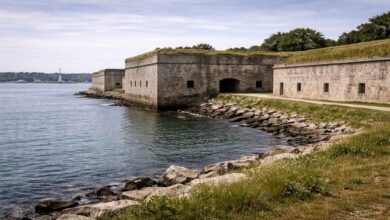
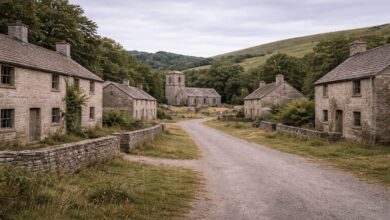
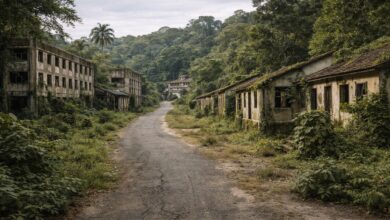
On the banks of the Scheldt River in northern Belgium, the village of Doel sits pressed against infrastructure far larger than itself. Once a functioning rural community, Doel became encircled by port expansion and industrial planning. Its decline did not arrive suddenly. It arrived through stages, pauses, and partial returns. The result is a village that still stands, yet no longer functions as a whole.
What remains today is not a ruin erased by time, but a place thinned by attrition. Streets remain aligned. Houses remain upright. Life receded gradually, leaving structure behind.
Absence accumulated.
A village caught in expansion
Doel’s history is inseparable from the growth of the Port of Antwerp. As industrial ambitions expanded along the river, surrounding land was designated for future development. The village was marked for removal long before it was emptied.
Expropriation unfolded slowly. Residents were bought out in phases. Some stayed. Others left. Daily life continued under uncertainty. Similar human responses to silence and environment appear in Ruins of Kuldhara.
The future hovered without resolution.
Departure without a single moment
Unlike villages cleared by disaster or decree, Doel emptied unevenly. Years passed between departures. Empty houses appeared beside occupied ones. Streets became partially lit.
This gradual thinning altered social cohesion. Familiar routines fractured. Community weakened not through collapse, but through repetition of loss.
Leaving became normal.
Architecture that records withdrawal
Doel’s buildings preserve the evidence of staged departure. Curtains remain in some windows. Others are broken or boarded. Gardens range from tended to overtaken.
Graffiti fills walls not as decoration, but as occupation of vacancy. Art arrived where daily life withdrew.
Expression replaced routine.
Industry as constant presence
The nearby nuclear power plant and port infrastructure dominate Doel’s horizon. Their scale overwhelms the village. Sound, lighting, and movement continue uninterrupted.
This proximity intensifies contrast. Industry functions continuously. The village does not.
Permanence and impermanence coexist.
Control through uncertainty
Access to Doel has shifted repeatedly. At times restricted, at times reopened, the village exists in an administrative limbo. Demolition was announced, delayed, revised.
This uncertainty deepened absence. Without clear end or renewal, the village remained suspended.
Suspension became identity.
Haunted reputation through emptiness
Doel is often described as haunted, yet its atmosphere emerges from emptiness rather than myth. Quiet houses, exposed interiors, and inconsistent occupation heighten awareness.
The sense of unease reflects interruption. A place designed for continuity now operates without it.
Design outlasted purpose.
Documented beyond the page
The village has also drawn attention beyond written documentation. Doel was featured in an independent video exploration that records its streets, structures, and spatial relationship to the surrounding industrial landscape. The footage provides a visual impression of scale, proximity, and atmosphere that complements written observation without replacing it. The video is linked here as a supplementary visual reference only and does not inform the analysis, conclusions, or interpretive framework presented in this article – View video documentation.
A community erased in increments
Doel’s residents did not disappear together. They aged, relocated, and dispersed individually. Collective memory dissolved unevenly.
What remains is a village missing its center. Shops closed. Institutions vanished. Only fragments of domestic life persist.
Hollowing replaced collapse.
Why Doel still resonates
Doel matters because it illustrates how abandonment can occur through planning rather than failure. It shows how communities can be removed without spectacle, leaving form intact but meaning diminished.
The village does not rely on decay to communicate loss. Its clarity lies in partial presence.
It remains unresolved.
Between preservation and erasure
Doel occupies a contested space between heritage and utility. Some buildings are protected. Others await removal. The village stands under constant review.
This liminal status shapes perception. Nothing feels finished.
The village is held open.
Enduring Perspective
Doel endures as a village emptied not by catastrophe, but by prolonged uncertainty. Its streets remain walkable. Its houses remain visible. Yet the social core that once connected them has dissolved. In the shadow of industry, Doel demonstrates how slow departure can hollow a place more thoroughly than sudden loss. Here, absence did not arrive at once. It stayed, and stayed again, until nothing essential remained. Related reflections on memory and perception can also be found in Humberstone.
Horizon Report documents places shaped by memory, infrastructure, and human decision making. Our work focuses on what remains physically visible, how abandonment unfolds, and how interpretation is clearly separated from observable evidence.
For additional context, the following background articles explore patterns of abandonment, loss of use, and preservation.
- Abandonment And Ghost Towns
- What Is A Ghost Town
- Why Towns Are Abandoned
- Preserving Abandoned Places
Editorial transparency matters. Observations are grounded in site layout, materials, remaining structures, and documented timelines. Interpretation is presented as interpretation, not assertion.
Attentive readers often spot refinements worth making. Thoughtful feedback supports accuracy, clarity, and long term editorial integrity.